
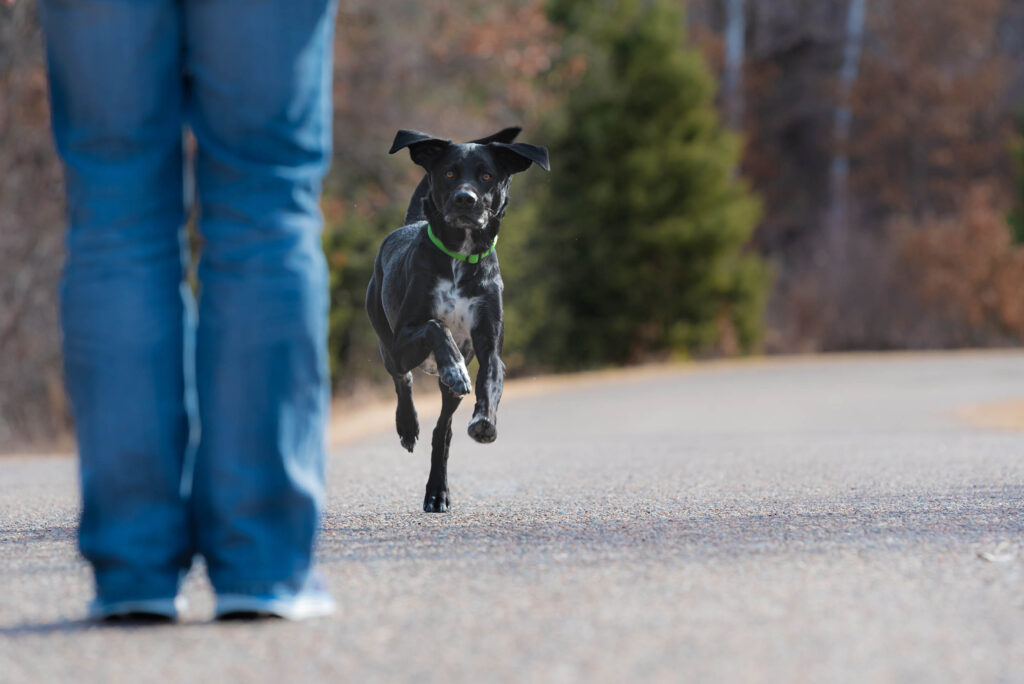
The ability to call your dog and know, without a doubt, that they will come running back to you is the foundation of ethical dog ownership. A reliable recall is a fundamental, potentially lifesaving safety skill for your dog, and understanding how to teach a dog recall is a prerequisite for enjoying the beautiful off-leash areas around Denver, Boulder, and the Colorado mountains safely.
Why do so many owners struggle? Dogs do not automatically generalize behavior, meaning a perfect recall in the kitchen can fail instantly when a critter runs by on a dog-friendly trail. The strategic solution is a system that moves beyond basic commands to incorporate advanced troubleshooting, reward fading, and integration with foundational control behaviors.
Teach Your Dog Recall by Building a High-Value, Happy Association
A reliable recall means your dog enthusiastically responds to the cue 99.99% of the time, even when highly distracted. The goal is to make coming to you the single best, most rewarding thing your dog can do.
Positive Reinforcement and High-Value Rewards
Training must be fun and happy. Your dog must associate coming with the absolute best experience. Building this positive association requires you to be the most exciting thing in your dog’s world. When your dog makes the choice to turn away from a distraction and return to you, they deserve a significant payout. By consistently using rewards that your dog truly loves, you create a powerful motivation that holds up even in high-stakes environments.
- The Reward Hierarchy: Always use High-Value Treats (HVTs) or favorite toys, especially as the difficulty increases. Think boiled chicken or cheese cubes rather than standard kibble.
- Motivation is Key: The reward should be exciting and unpredictable to maintain motivation. Use a “jackpot” reward occasionally, where you give a flurry of 5-10 treats for an exceptionally fast or difficult recall.
Avoiding the “Poisoned” Cue
The most common reason for recall failure is the owner unintentionally poisoning the cue. This happens when the dog begins to associate the recall word with the end of fun or a negative consequence. If your dog hears their name and thinks they are about to be put on a leash or taken away from the park, they will start to hesitate. We want to protect the integrity of your recall word by ensuring it only predicts wonderful things for your furry companion.
- Never punish the cue: Do NOT use the recall cue for negative events, such as leaving a fun activity, ending playtime, punishment, or when you are angry. The cue should predict something wonderful, not the end of fun.
Tip: Always call your dog more times than you actually need them to come. Instead of only calling them to you once then putting the leash on and heading home, call the dog to come 4-6 times during their off-leash adventure, reward them, then release them to return to play. If you keep the odds in your favor, your pup will think of “come” as just a quick check-in instead of the end to your fun.
- Stop repeating: Avoid repeating the cue (e.g., “Lilly! Come! Come!”). This teaches your dog that the first few calls are irrelevant. If your dog fails, go back a step and make the task easier.
- The fix: If you suspect your cue is poisoned, choose a new, unique cue word (like “Here” or “Touch”) and start over with all the positive foundation work.
Training Stages and Essential Exercises for Teaching a Dog Recall
The key to reliability is moving through environmental control stages methodically. You cannot expect a dog to listen in a busy Boulder park if they have not mastered the skill in your own hallway. We move through these stages to build confidence and help the dog generalize the command across different settings. Taking your time with each phase ensures that your dog has a solid understanding before you ever consider dropping the leash.
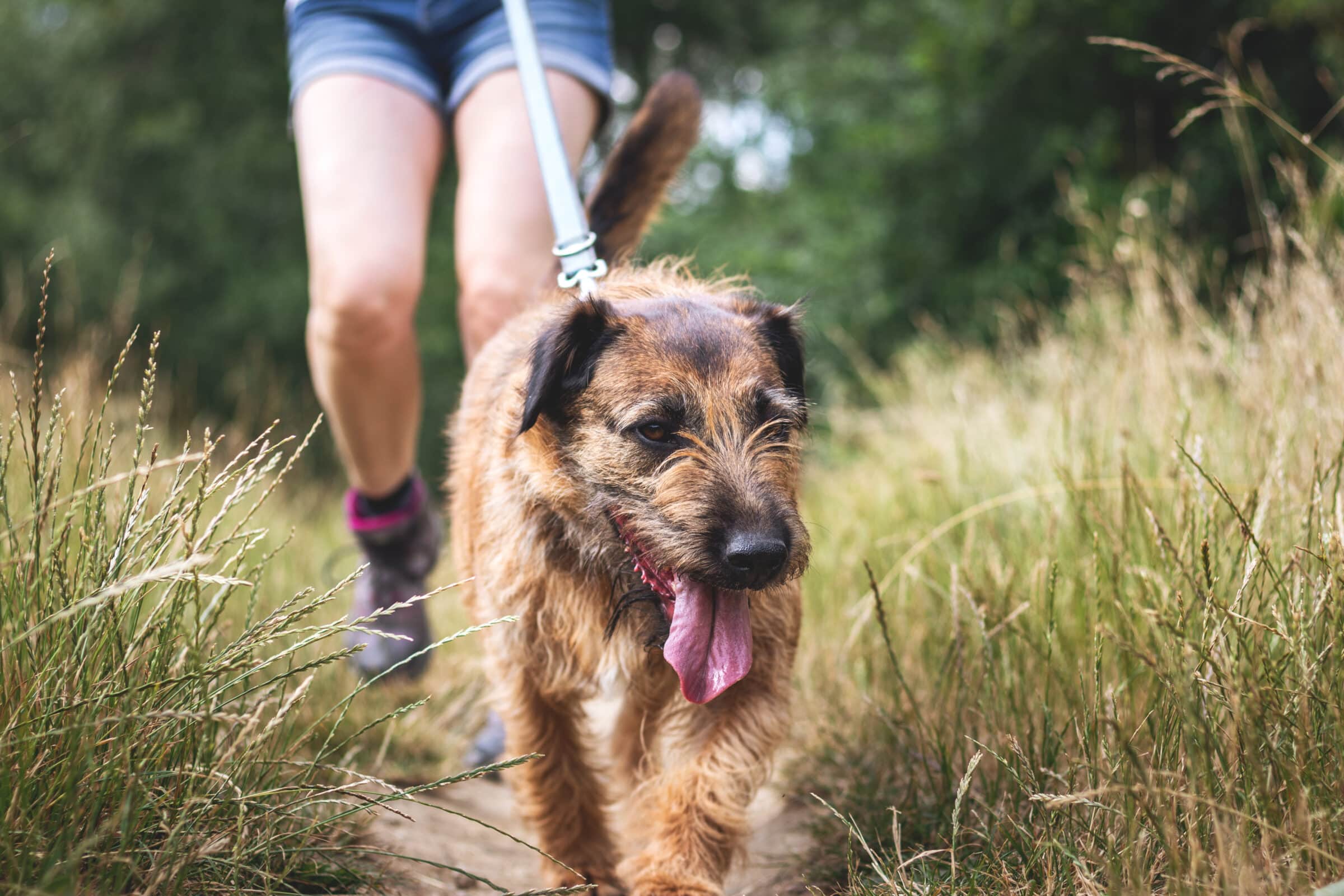
The Three Stages of Environment Control
- Stage 1 – Low-Distraction: Start indoors to ensure a high rate of success with minimal distractions.
- Stage 2 – The Long Line: Begin training on a standard leash, then transition to a long line (20-50 ft) in a fenced area. This allows you to practice distance and gives you a safety brake before attempting off-leash.
- Stage 3 – Proofing and Generalizing: Only when your dog is 90%+ reliable on the long line in a given location do you begin off-leash, and only then in a truly low-risk, designated area.
Essential Recall Training Games
Games are an essential part of how to teach a dog recall, and they tap into your dog’s natural instincts. Instead of making training a chore, these exercises turn coming when called into a favorite activity. These games are designed to inject speed, distance, and enthusiasm into the behavior.
- Run Away/Back Away: Say the cue and immediately run a few steps away from your dog. This triggers the dog’s natural chasing instinct, making coming to you a fun game.
- Round Robin/Hot Potato: Two or more people take turns calling and rewarding the dog. This teaches the dog to respond regardless of who gives the cue.
- Find Me/Hide-and-Seek: Call the dog from another room or behind a tree. This builds speed and the ability to come to you when they cannot see you.
Generalizing and Proofing the Behavior
Dogs do not automatically generalize. A successful recall in your backyard is not a successful recall at the Chatfield State Park off-leash area.
- Practice in New Locations: Practice in new, different locations such as parks or other homes.
- Introduce Distractions Slowly: Add distractions (other people, dogs, toys) slowly, always setting your dog up for success.
- If Failure Occurs: If the dog fails, reduce the difficulty or distraction level immediately. Never punish or get frustrated.
Advancing Control and Reward Fading
True reliability is about control and motivation maintenance. Once your dog is consistently returning to you, we need to focus on what happens when they arrive. Proper control at the end of a recall is what keeps your dog safe in real-world situations, such as near a busy road or a crowded trail.
Finish by Chaining Recall to Sit and Collar Grab
It’s not enough to understand how to teach a dog recall unless you can also have control of your dog when he or she comes back to you. We suggest chaining the recall to an automatic “Sit” and a comfortable collar grab.
- Automatic Control: The automatic sit provides a momentary pause/control, essential for leashing or giving directions.
- Collar Grab Desensitization: Use the “reach and reward” game. As your dog approaches, reach for their collar, say a word like “Gotcha,” and immediately reward them with a HVT while you are holding the collar. This ensures they do not dance out of reach.
Transitioning to Intermittent Reinforcement
To maintain reliability long-term, you must move from rewarding every recall (continuous reinforcement) to intermittent reinforcement.
- The Transition: Once the behavior is reliable, begin rewarding only some of the successful recalls (e.g., reward 7 out of 10, then 5 out of 10).
- Life Rewards: Substitute food rewards with life rewards. For example, recall your dog, reward with praise and a brief game of tug, and then allow them to return to playing. The reward is getting to do what they wanted.
- The Surprise Jackpot: Always surprise your dog with a jackpot reward occasionally, even years later, to keep the behavior fresh and the motivation high.
Advanced Troubleshooting
| Failure Point | Why it Happens | Expert Strategy |
|---|---|---|
| Dog stops halfway to sniff/pee | The environment reward is briefly higher than your reward value. | Use a body language marker (praise) just before they stop. Change direction and run away from them to reactivate the chase instinct. |
| Dog bolts toward another person/dog. | High-value distraction or socialization desire overrides your cue. | Use an emergency, high-intensity sound cue (like a whistle) before the distraction is reached, and immediately increase the distance next time. |
| Highly driven dog ignores the cue (prey/scent drive). | Verbal cues are often emotional and easily overridden by instinct. | Use a whistle/different sound cue for long-distance emergency recall. A whistle is a neutral sound that cuts through noise and is less emotional than a verbal cue. |
Leash Laws and Off-Leash Etiquette
Granting off-leash freedom in Colorado comes with legal and ethical responsibilities. The Code of Colorado Regulations states that to be permitted on Parks and Outdoor Recreation Lands, any dog must be under control and on a leash under six feet in length. Exceptions include designated dog off-leash areas at Chatfield and Cherry Creek State Parks.
- An unreliable recall can harm public access for all dog owners, leading to stricter local leash laws for everyone.
- Your dog must be fully proofed across many environments before you grant them off-leash freedom. Always know your local regulations, respect other trail users, and keep visual control.
The Freedom of Complete Control
Learning how to teach a dog recall is the single largest investment you can make in your dog’s safety and quality of life. It gives you the unquestionable safety of a verifiable, lifesaving response in emergencies, and the expanded freedom to enrich your dog’s life through safe, legal off-leash activities. It eliminates the stress and conflict of a dog that “won’t come when called,” replacing it with confidence and trust.
If the methodical, step-by-step commitment of proofing and reward fading feels overwhelming, consider the immense value of a structured, professional training environment. Our BlackPaw Boarding School Programs are designed to install and proof these advanced behaviors, integrating the recall with the necessary control behaviors (like the automatic Sit and Collar Grab) to deliver lasting, real-world reliability when your dog returns home.
Begin today by mastering the foundational skills in a low-distraction environment, then methodically apply the Intermittent Reinforcement and Collar Grab strategies for enduring, real-world reliability.