
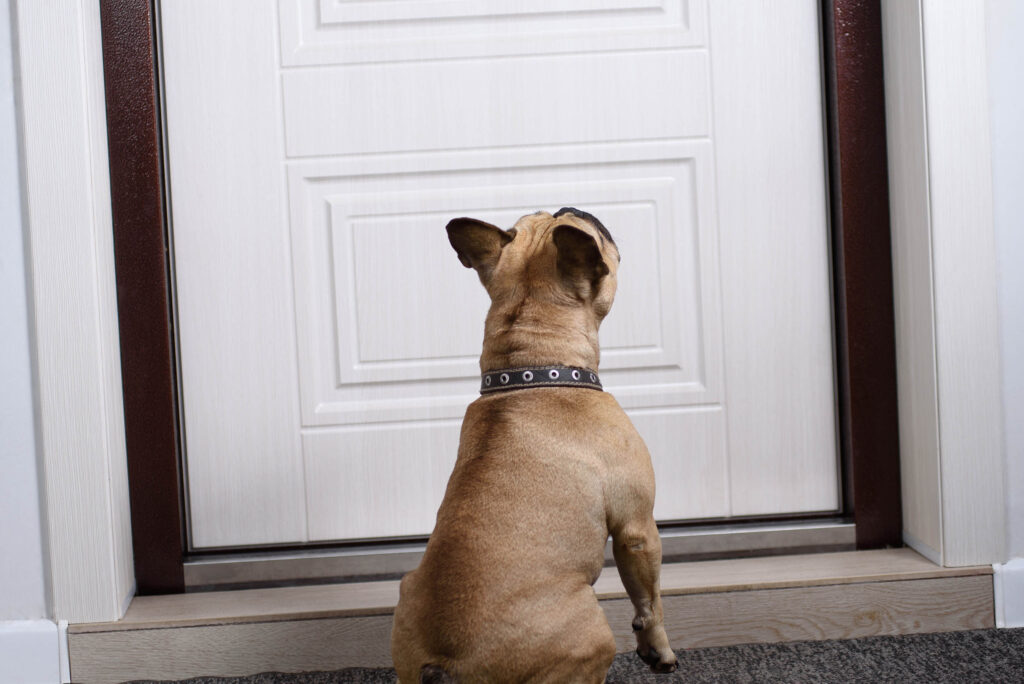
We know how frustrating it is when your dog’s behavior affects your quality of life. At BlackPaw Dog Training, we understand that this behavior is a symptom of a deeper issue that stems from a gap in communication and structure. If you’re at your wit’s end and asking yourself “why do dogs bark at doorbells?”, then this guide is for you.
- The 3 Core Motivations for Barking at Doorbells
- How to Read the Difference Between Excitement vs. Fear
- Managing the Environment: 3 Ways to Stop the Reaction Cycle
- 5 Ways to Stop a Dog from Barking at a Doorbell
- How to Stop Your Dog from Barking at the Doorbell
The 3 Core Motivations for Barking at Doorbells
To truly stop the barking, we must first understand why dogs bark at doorbells. Trying to silence the symptom without addressing the cause is like yelling at a fire alarm instead of putting out the fire.
Alerting & Territorial Drive
Your dog views your home as their territory and your family as their “pack.” When the doorbell rings, they interpret it as an intruder announcing their presence. Their instinct is to bark to warn you and deter the threat. While a quick “Woof!” is normal, excessive, sustained barking signals a breakdown in the human-dog partnership, meaning the dog feels compelled to take the lead and handle the threat themselves because they don’t trust you to do it.
High Excitement & Anticipation
For many happy, high-energy dogs (like the Labs and Aussies common in our Colorado community), the doorbell is a predictor of a highly rewarding social event: A guest! Playtime! Attention! Their excessive barking is simply a frustrated, unchanneled expression of intense enthusiasm. They literally can’t contain their excitement.
Fear, Anxiety, or Startle Response
This is often the deepest cause of why dogs bark at doorbells. Because dogs have much more sensitive hearing than we do, the sudden, loud noise of the bell genuinely startles them. If your dog is fearful of strangers or has generalized anxiety, the doorbell is a frightening sign that an unknown, potentially scary person is about to enter their safe space. It’s important to note that punishing a bark rooted in fear only reinforces the dog’s anxiety and teaches them to hide their warnings, making the situation potentially more volatile.
How to Read the Difference Between Excitement vs. Fear
Identifying the root cause tells you which training path to take and helps answer the question of how to stop your dog from barking at doorbells. Watch your dog’s body language immediately after the bell rings:
| Body Language Sign | Excitement (Anticipation) | Fear/Anxiety (Territorial) |
| Tail/Body | Loose, full-body wag; running back and forth; relaxed mouth. | Tail tucked or low; body stiff or low to the ground; shaking/pacing. |
| Bark Type | High-pitched, frantic, often escalating in pitch; stops quickly upon distraction. | Low growls or high, frantic alarm barks; hard to interrupt; pupils dilated. |
| Focus | Runs to the door and focuses intensely on the perceived visitor. | Looks to you for guidance/safety; may retreat and bark; unable to take high-value treats. |
Managing the Environment: 3 Ways to Stop the Reaction Cycle

The first step in any behavioral shift is preventing the dog from rehearsing the unwanted behavior. Every time your dog gets to bark uncontrollably at the doorbell, the habit is reinforced. Use these three management techniques for immediate relief while training begins.
Block Sightlines
If your dog is allowed to patrol the windows and bark at every person or dog passing by, they are in a constant state of arousal and are primed to explode when the bell rings. Close the blinds or use window film on all front-facing doors and windows to eliminate the visual trigger.
Diffuse the Sound Trigger
Reduce the startling effect of the doorbell by masking the noise. Use a white noise machine, fan, or music near the front of the house. This reduces the clarity and intensity of the sudden “Ding-Dong,” lowering your dog’s anxiety threshold.
The Knock/Text Protocol
While you are actively training, you must stop the trigger altogether. Place a polite, clear sign on your front door asking visitors and delivery drivers to please knock or text instead of ringing the bell. Stress this as an essential temporary boundary that gives you control over the timing of the trigger, setting both you and your dog up for success.
5 Ways to Stop a Dog from Barking at a Doorbell
The ultimate goal of training is to give your dog a better job than barking. We are using Balanced Training (encouragement + boundaries) to teach an incompatible behavior that replaces the frantic rush to the door.
1: The Foundational Command
The “Place” command is the single most important tool for controlling door chaos. It teaches your dog to go to a designated bed or mat and stay there regardless of distraction.
- The Rule: When the bell rings, your dog must immediately be sent to Place. This technique works on the principle of incompatible behavior, as they cannot rush the door and bark if they are lying down 15 feet away.
- Application: Start training “Place” away from the door with high-value treats. Only once they are successful, introduce the doorbell trigger at a volume where they can succeed, reinforcing the moment they respond to the cue.
2: Leader’s Posture: Control Your Energy
Your demeanor is your dog’s mirror. If you rush, tense up, or shout when the bell rings, you are confirming to your dog that the situation is a crisis and they need to intervene.
- When the doorbell rings, you must project calm, assertive leadership. Move slowly, speak calmly (if at all), and maintain your composure.
- Yelling is perceived as you joining the fray. Your dog needs a wise, passionate mentor to guide them, not a partner in panic.
3: Structured Desensitization
Your dog will never be able to ignore the doorbell, so the goal is to change his or her emotional response to the sound. Desensitizing your dog to the doorbell is one of the best ways to stop their barking.
- We recommend playing doorbell and knocking sound effects from YouTube on a wireless speaker while working on the ‘Place’ command. Once they are successful with the audio tracks, you can progress to practicing with your home’s actual doorbell while practicing Place!
4: Consistency in Real-World Scenarios
Mail and package deliveries are the most common daily triggers, demanding absolute consistency.
- Practice the Place command daily, building distraction (knocks, footsteps).
- During a real delivery, command “Place.” Reward heavily with a high-value, long-lasting item (like a frozen Kong) the moment they lie down. Do not release them from Place until the visitor is gone and the environment is quiet. This ensures the delivery event is associated with focused calm, not chaos.
5: Address the Imbalance with Mental and Physical Exhaustion
A large, high-energy dog that is bored or under-exercised has excessive energy to expend on barking fits.
- An occasional short walk is often an insufficient outlet for your dog’s energy. They need high-intensity physical activity (hiking, running) and mental stimulation (advanced obedience work, puzzle toys).
- A dog whose mind and body are balanced has far less energy to reserve for frantic, anxious reactions. This is essential for sustainable success.
How to Stop Your Dog from Barking at the Doorbell
While these five methods can work for mild-to-moderate doorbell chaos, we understand that for many owners, the problem runs deeper. Certain dogs may have an uncontrollable response that lets loose as soon as a stranger approaches your door.
If the barking is rooted in severe fear, aggression (growling, lunging), or anxiety that is overwhelming your ability to train, the solution often moves from at-home training to professional intervention. You love your dog, and your dog loves you. You both deserve a definitive solution that gives you back your freedom and removes the doorbell stress from your dog’s life.
When your dog won’t stop barking at the doorbell, and nothing else works, it may be time to consider BlackPaw Dog Training’s Total Behavior Reboot Boarding School Program. Our immersive, consistent training environment, combined with the proven expertise of a Search & Rescue handler, provides the profound, lasting change that home classes simply cannot achieve.
If you are frustrated, exhausted, and ready for a transformed dog and the total peace of mind that comes with perfect, real-world control, contact BlackPaw Dog Training today.